© 2026 Rentokil North America © Gregory Pest Solutions – All Rights Reserved.
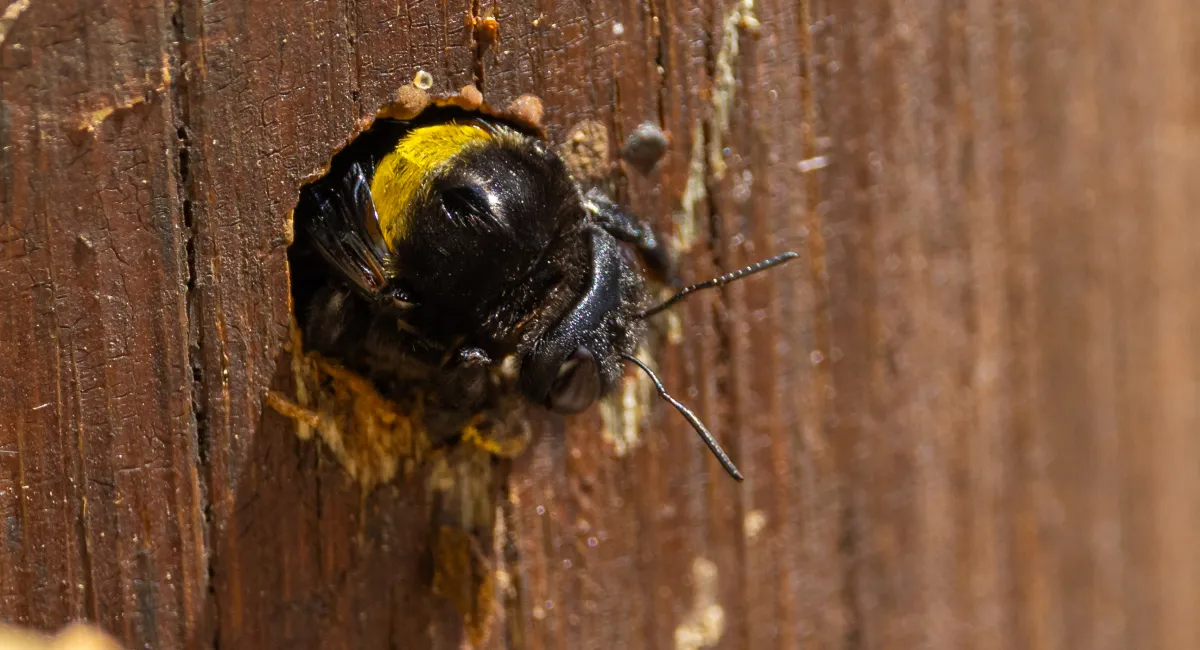
Those perfectly round holes appearing in your deck railing this spring aren't weathering; they're carpenter bees boring into the wood to nest. And unlike a scratch or a stain, this damage doesn't stay the same. It gets worse, year on year, as the same tunnels are reused, expanded, and joined by new ones, gradually weakening the wood from the inside out.
Carpenter bees are just one part of a broader spring pattern across North and South Carolina. Right now, paper wasp queens are scouting sheltered spots under eaves and soffits. Yellow jacket queens are establishing ground nests that won't be visible until the colony is large enough to be dangerous.
This guide breaks down the types of stinging pests Carolina homeowners are most likely to come across this spring, what you can realistically do on your own, and when professional support is needed.
1. Carpenter Bees: The Damage You Don't See
Carpenter bees are often disregarded because they don't seem like a threat. Males hover aggressively but can't sting, and females rarely do, so most homeowners simply learn to live with them. The holes they leave behind don't raise much concern either: clean, round, about the width of a finger, and easy to dismiss as minor.
What isn't visible is the damage behind those holes. Female carpenter bees bore inward, then turn at a right angle to carve out galleries where they lay eggs. These tunnels can extend several inches deep, and when the next generation emerges, they often reuse and expand the same passages, while boring new ones nearby.
What Compounds the Problem
Repeated boring weakens railings, fascia boards, pergolas, and other exposed wood structures, allowing moisture to seep through unsealed holes and accelerating rot. Moreover, woodpeckers are drawn to the larvae inside, tearing into the wood and turning hidden damage into visible destruction.
Many homeowners don't connect the dots until they notice soft spots in a railing or a board that gives way unexpectedly. By then, the damage has been building for years.
What You Can Do
If you catch activity in the first season, there are reasonable steps to take:
- Treat active holes with an appropriate insecticidal dust applied into the gallery
- Wait several days, then seal the holes with wood putty or dowels
- Paint or stain exposed, untreated wood; carpenter bees strongly prefer bare wood
These steps can slow activity, but are unlikely to stop it completely, especially if the bees have already established a pattern at that location. When damage spans multiple areas or recurs across multiple seasons, a more targeted and thorough approach is usually necessary.
2. Paper Wasps: Manageable Early, Less So Later
Paper wasps (Polistes carolina) are the stinging insects most homeowners encounter first in spring. Their nests are easy to spot. They consist of umbrella-shaped structures typically found under deck railings, along rooflines, inside grills, or tucked into the corners of door frames.
In April and May, these nests are small, often containing just a queen and a handful of cells. At this stage, they're relatively low-risk and accessible.
When DIY Is Reasonable
A single, early-season paper wasp nest in a visible, reachable location is one of the few stinging insect scenarios where DIY treatment is genuinely practical—provided no one in the household has a known allergy to stings, and you can treat from a safe distance.
Standard wasp sprays are effective on small nests when applied in the evening, when wasps are less active.

When the Situation Changes
By June and July, paper wasp colonies grow significantly. Nests become larger, workers become more defensive, and activity increases around high-traffic areas, such as patios, doorways, and children's play areas.
Nests built inside soffits, wall voids, or other enclosed spaces also present a different challenge. They're harder to access, harder to fully treat, and more likely to cause stinging during removal. If you're finding multiple nests around the property, or nests in locations that aren't safely reachable, that's a clear signal to step back from the DIY approach.
3. Yellow Jackets: The One You Shouldn't Handle Alone
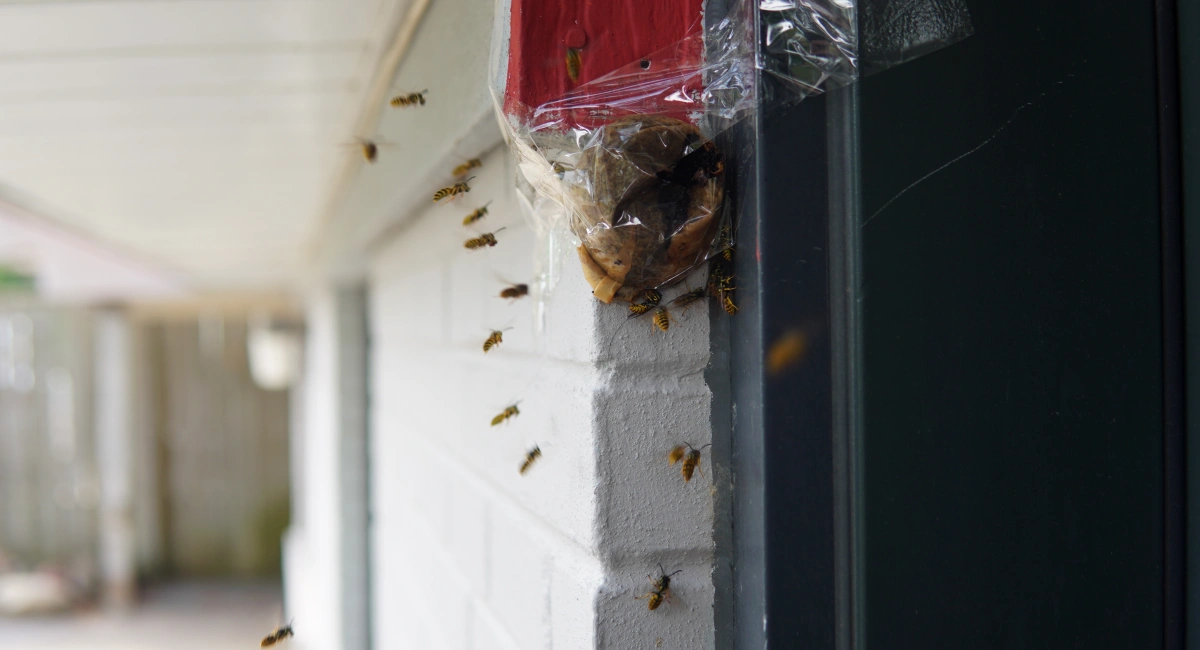
Yellow jackets occupy a different category entirely. They're more aggressive, more likely to sting in numbers, and their nests are often hidden underground, inside retaining walls, or within wall cavities.
How They Show Up
Most homeowners discover yellow jacket nests by accident. Common scenarios include:
- A sudden swarm of insects rising from a hole in the yard while mowing
- Increased wasp traffic near a gap in the foundation or siding
- Aggressive behavior near a specific spot in the landscape
By the time the nest is noticeable, it's usually well-established. A queen that began building in May can produce a colony of 4,000 to 5,000 workers by late summer.
Why DIY Doesn't Work Here
Pouring boiling water into a ground nest, covering the entrance, or using consumer sprays on a yellow jacket colony almost always makes the situation worse. These insects are fast, defensive, and capable of stinging repeatedly. Incomplete treatment agitates the colony without eliminating it, increasing the risk of a serious encounter, especially for children, pets, or anyone with an allergy to stings.
This is the scenario where being honest is prudent: yellow jacket nests are not a DIY project. The risk of injury is real, and the margin for error is small. Professional treatment with proper equipment and technique is the appropriate response, even for a nest discovered early.
Timing Is the Variable You Control
Across all three scenarios, the common thread is timing. Spring activity is early-stage activity. Colonies are small. Carpenter bee damage is limited. Nests are just forming.
By midsummer, every one of these situations escalates:
- Carpenter bee tunnels are deeper and more widespread
- Wasp colonies are larger and more defensive
- Yellow jacket nests are fully populated and highly aggressive
The cost of waiting isn't just financial, although repairs and treatments will start to pile up later in the season. It's also about safety, disruption, and the complexity as colonies expand.
A Realistic Framework for Action
Not every stinging insect sighting requires a phone call, and not every situation is safe to handle alone. Here's a practical way to think about it:
Handle it yourself when:
- You've found a single, small paper wasp nest in an open, accessible spot
- Carpenter bee activity is new, limited to one or two holes, and the wood is otherwise sound
- You're taking preventative steps like sealing or painting exposed wood
Bring in professional support when:
- Carpenter bee damage has been recurring across seasons or spans multiple structures
- Wasp nests are in enclosed or hard-to-reach areas
- You're dealing with yellow jackets—full stop
- DIY efforts haven't resolved the issue
- Anyone in the household has a sting allergy
There's no value in overstating the risk of a single paper wasp nest. But there's real value in recognizing when the situation has moved beyond what a can of spray and a ladder can solve.
What May Looks Like for Carolina Homeowners
Right now, across North and South Carolina, stinging insect activity is ramping up. Carpenter bees are actively boring. Wasp queens are building. There are signs of yellow jacket colonies in hidden locations.
The most effective thing a homeowner can do this month is walk the property with fresh eyes. Check deck railings and fence posts for new holes. Look under eaves and along rooflines for early nests. Pay attention to ground-level insect traffic in the yard.
If what you find is minor and accessible, early action on your own can make a real difference. If what you find is more than that, or if you're not sure what you're looking at, a quick conversation with a pest management professional can clarify the situation and help you decide on the next steps before it gets worse.
Book Your Free Pest Inspection Today
Our local technicians will assess your property and recommend tailored solutions. Fast, friendly, and completely obligation-free.
- Safe, targeted treatments
- Local experts, fast response
- Trusted, trained technicians